

Alison Muller
July 28, 2026


AI is quickly reshaping Life Sciences commercialization, creating an opportunity to use Agentic AI to reduce complexity and help people work more effectively—not simply add another tool to the commercialization model.
Customer-facing professionals already move among numerous systems and applications to complete their daily work. Adding an AI assistant to each platform may make individual tasks faster while leaving people to navigate an increasingly disconnected technology ecosystem.
Tasks become more efficient. Work remains fragmented.
The greater opportunity is to treat Agentic AI as a structural transformation of commercialization—simplifying work across systems, functions, and moments. By finding information, coordinating activities, and supporting decisions in the background, AI can give people more time for the work that requires judgment, empathy, credibility, relationships, and trust.
The future of Life Sciences commercialization will be shaped not by how many AI tools an organization deploys, but by how effectively AI strengthens the people bringing therapies to market.
Why AI Productivity Alone Cannot Transform Life Sciences Commercialization
Much of the discussion around AI has focused on productivity: creating content, summarizing documents, automating administrative tasks, or answering questions faster.
These benefits are useful, but they do not address the broader structure of commercialization. A sales representative may receive a faster answer but still need to confirm whether it is current and approved. An MSL may get a clinical summary but still have to locate the original source. A field reimbursement specialist may automate one step while manually coordinating the rest of the process.
Point solutions can accelerate isolated activities without reducing the overall burden on the workforce.
That burden is becoming harder to absorb as product portfolios expand, launch timelines compress, and customer-facing functions face continued pressure to do more with less. Sales, Medical, Marketing, Market Access, Patient Services, and Learning and Development teams need greater capacity without losing the human capabilities that shape successful commercialization.
This requires more than automation. It requires orchestration.
Move from System-Based AI to Role-Based Agentic AI
Most enterprise technologies are designed around systems. CRM agents support CRM activities. Content agents support content platforms. Learning agents support learning systems.
People do not experience their jobs one system at a time.
A field professional may prepare for an HCP meeting, review clinical information, confirm approved messaging, record an insight, complete a follow-up, and identify the next best action. That work crosses multiple systems and requires different forms of context.
Role-based Agentic AI begins with the person and the outcomes they are responsible for achieving. It coordinates approved information, systems, workflows, and other agents around the role.
This changes the questions organizations should ask:
- What prevents this person from performing at their best?
- Where does complexity interrupt customer or patient engagement?
- Which activities can AI support so people have more time for higher-value work?
The shift from optimizing systems to augmenting roles can improve work across commercialization. Sales teams can access approved information and prepare for calls more efficiently. Medical teams can accelerate evidence retrieval and support KOL engagement. Marketing can better connect strategy, content, and field execution. Market Access and Patient Services can reduce administrative friction, while Learning teams can deliver more focused reinforcement.
The objective is not to turn these functions into automated workflows. It is to give professionals more capacity to apply their expertise where it creates the most value.
Making that shift requires more than designing an AI agent around a job title. To support the full role, Agentic AI must understand the person and their work, connect information and activities across systems, operate within clear boundaries, and earn adoption from the people it supports. These are the capabilities that turn role-based AI from an idea into a practical model for commercialization.
The 4 Cs That Make Role-Based Agentic AI Work
Structural transformation requires more than technical capability. Agentic AI must understand the work, connect what is fragmented, operate within clear boundaries, and be adopted by the people it is intended to support.
These requirements come together in the 4 Cs: Context, Connection, Control, and Change Management. Together, they provide the foundation for Agentic AI that supports people across their roles—not simply another task within their workflow.
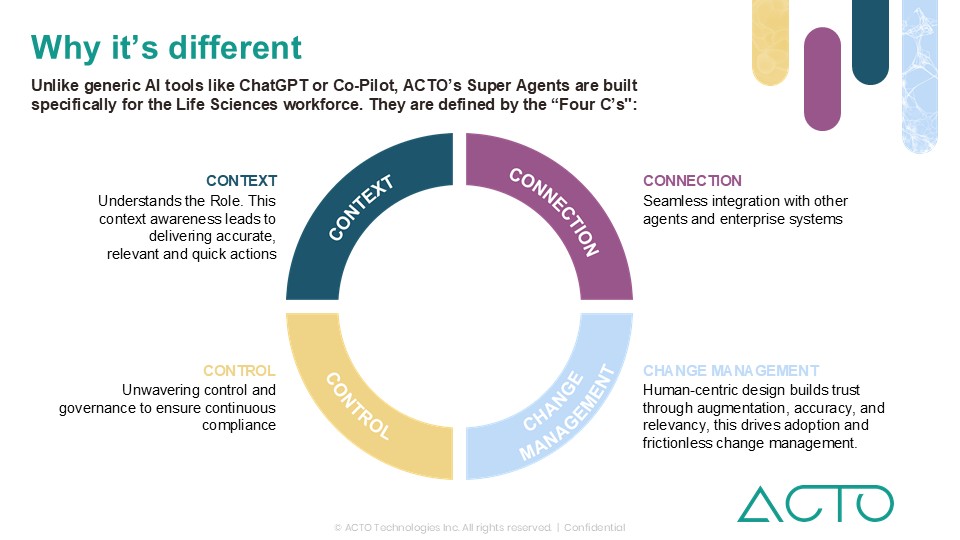
Context
Generic intelligence is not enough for regulated, role-specific work.
AI must understand the professional’s role, responsibilities, objectives, approved information, and working environment. An MSL requires different support from a sales representative, market access manager, or patient services professional.
Context turns a general-purpose assistant into relevant, role-aware support. It helps ensure that the information or action presented is appropriate to the user, situation, and boundaries of the role.
Connection
Commercialization work is distributed across content repositories, learning platforms, CRM systems, policies, clinical resources, communication tools, and external data.
If AI operates within only one of those systems, it sees only part of the job.
Connection allows an agent to work across approved enterprise sources, systems, and other agents. The professional gains a more unified way to prepare, find information, complete activities, and capture insights without manually piecing together the process.
The goal is not to replace the existing technology ecosystem. It is to reduce the burden that ecosystem places on the people using it.
Control
In Life Sciences, convenience cannot come at the expense of accuracy, compliance, or accountability.
Agentic AI needs defined permissions, approved sources, role-aware boundaries, transparent decision paths, human oversight, and auditable activity. Control should be built into how an agent operates—not applied after deployment as an additional review step.
This allows AI to act with greater independence while remaining within the professional, organizational, and regulatory standards governing the work.
Change Management
Even technically capable AI will fail if employees do not understand it, trust it, or see its relevance.
Change management cannot begin after deployment. People need to understand what an agent does, where its information comes from, what it cannot do, and how it will help them perform more effectively.
Role-based AI makes that value easier to see because it is designed around the employee’s actual needs. Adoption becomes part of the operating model—not a separate phase to address once implementation is complete.
The purpose is to augment people, not diminish their expertise or agency. The 4 Cs provide the foundation for that human-centered approach.
Structural Transformation Requires TRUST
The 4 Cs describe what effective Agentic AI needs. The ACTO TRUST Framework provides a structured approach for putting those principles into practice.
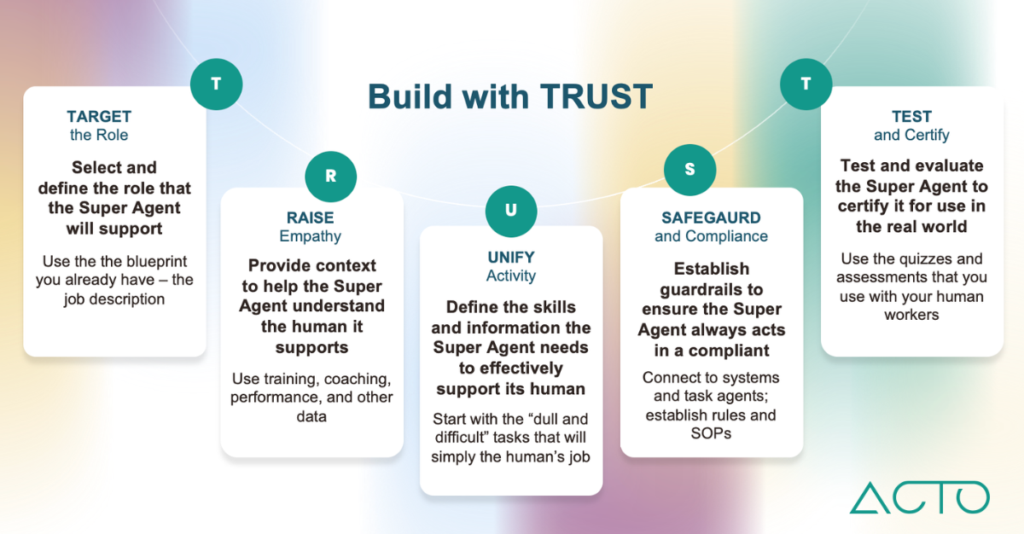
The framework begins by defining the agent’s operational persona using the same professional expectations that guide a human role. In practice, this means:
- Defining the agent’s role, responsibilities, permissions, and limitations
- Embedding boundaries that prevent activity outside its assigned scope
- Grounding responses and actions in company-approved information
- Logging decisions, interactions, and tool use for oversight and auditability
- Certifying the agent for field readiness before deployment
This is the difference between experimenting with Agentic AI and operationalizing it.
A sales rep or MSL would not be placed in front of an HCP without training, assessment, certification, and clear professional boundaries. An AI agent supporting that person should be held to similarly rigorous standards.
The ACTO TRUST Framework creates a path from AI exploration to responsible adoption while preserving compliance, accountability, and the human experience.
Put Complexity in the Background and People in the Foreground
The best application of Agentic AI may eventually be the one people notice least.
A field professional should not have to think about which system contains an answer, whether a document is current, where an insight should be recorded, or which workflow must be opened next. That complexity should increasingly be handled in the background.
What remains in the foreground is the human moment: listening carefully, interpreting clinical nuance, responding with empathy, exercising judgment, establishing credibility, and building trust.
That is the real promise of Agentic AI in Life Sciences commercialization. It is not simply faster content, automated tasks, or another assistant added to the technology stack. It is a new way to organize work around people.
When AI is role-aware, connected, controlled, and introduced through deliberate change management, it can help Sales, Medical, Marketing, Market Access, Patient Services, and Learning teams do more without simply asking people to absorb more work.
The future of commercialization is not AI replacing human execution. It is AI taking on more of the complexity that prevents people from executing at their best.
That is how Life Sciences organizations can address workforce constraints, improve effectiveness, and protect the human advantage at the center of every meaningful customer and patient interaction.
To go deeper into how Agentic AI could reshape Life Sciences commercialization, read Parth Khanna’s Agentic Commercialization Manifesto and subscribe to his Substack, The Agentic Dose, for more perspectives on the future of AI in Life Sciences.
Frequently Asked Questions
Agentic AI uses specialized agents to plan, coordinate, and complete work toward a goal. In Life Sciences, it should be designed around specific roles, approved information, enterprise systems, and compliance guardrails.
Agentic AI can reduce repetitive work, coordinate information across systems, improve preparation, provide faster access to trusted answers, support realistic practice, and turn field insights into more focused coaching and follow-up.
ACTO SuperAgents support the connected responsibilities of a professional rather than optimizing a single system. They provide one role-aware point of support across relevant information, tools, workflows, and agents.
No. Its strongest role is to reduce friction and strengthen human performance. Judgment, empathy, credibility, accountability, and relationship-building remain essential to effective HCP, payer, and patient engagement.