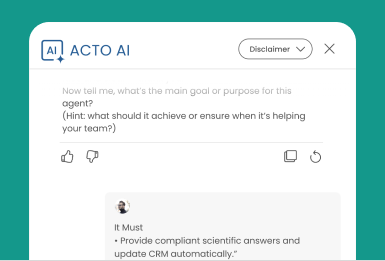
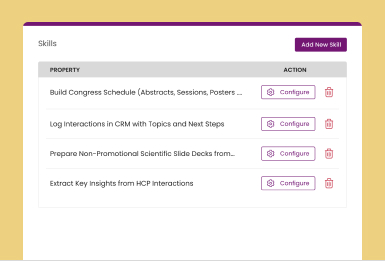
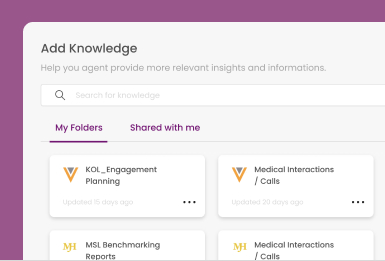
The final stretch in bringing new treatments to people in need happens in the field—educating HCPs, securing market access, and supporting patients. Empower these teams to perform at their best with their own personal AI SuperAgents.
15-30%
of a pharma company’s workforce is dedicated to commercialization.
To get started with AI in Life Sciences, focus on roles that are under the greatest pressure to do more with less, and that directly influence commercial outcomes. Customer-facing functions that have experienced layoffs, downsizing, or restructuring are especially well-suited for early AI impact.
The great news is, you already have the blueprint to get started—the Job Description. With ACTO, building a role-based SuperAgent is as simple as 1-2-3.
1.
Feed the job description into the ACTO SuperAgent Builder
2.
Select the appropriate agent skills and set compliance guardrails
3.
Connect the agent to the right data, systems, and task agents
Your field sales representative and MSLs must be certified before they are allowed to do their job—why shouldn’t AI agents be held to the same standard?
ACTO’s role-based SuperAgents go through the same rigor and certification as the humans they serve, to ensure they are trustworthy. SuperAgents are certified to ensure they understand the role of the human they are supporting, the boundaries of their reach, and the scope of their decision-making.

Director of National Sales Training, Currax Pharmaceuticals
See how ACTO’s role-based SuperAgents can transform your Life Sciences workforce.
“Helping our field-based teams have impactful, personalized conversations with HCPs is the ultimate goal. ACTO makes this possible by giving field professionals fast, role-specific access to the knowledge they need, along with relevant suggestions — improving pre-call planning and raising the quality of every HCP interaction.”
— Lisa Dreher
Director of National Sales Training, Currax Pharmaceuticals
When AI agents are designed to support roles rather than systems, Life Sciences organizations can apply AI to high-value use cases that consistently demand improvement.
In a highly regulated industry like Life Sciences, strict standards must be met before any system, application, or tool can be deployed—and agentic AI is no exception.
The Life Sciences industry is under enormous pressure to support expanded product portfolios and compressed launch timeframes, despite a significant human capital gap.