

Alison Muller
February 3, 2026


AI for Field Excellence is everywhere—but clarity is not.
Over the last few years, working closely with Life Sciences executives, we keep hearing variations of the same impossible equation:
- Board expectations: Up and to the right on everything—faster trials, expanded pipelines, digital transformation, regulatory excellence.
- Headcount reality: Flat. Or declining.
There is a massive Human Capital Gap between what field leaders are being asked to deliver and the human capital available to deliver. While AI seems like the obvious solution, “AI” has become a catch-all term that means different things to different people—leading to confusion about what’s actually possible.
If you’re trying to keep pace with the latest AI developments, you’re not alone. We often hear leaders express that they’re still wrapping their minds around how to define AI, articulate the various applications of the technology, and bring other team members up to speed.
Whether you’re looking to build or buy AI solutions, this quick guide will help you understand four available technologies and how they drive field excellence:
- Robotic Process Automation
- Large Language Models
- AI Agents
- Agentic AI
We’ll provide clear definitions without the hype, map available technologies to commercial challenges, and help you identify where to start based on your team’s needs.
Four Types of AI for Field Excellence
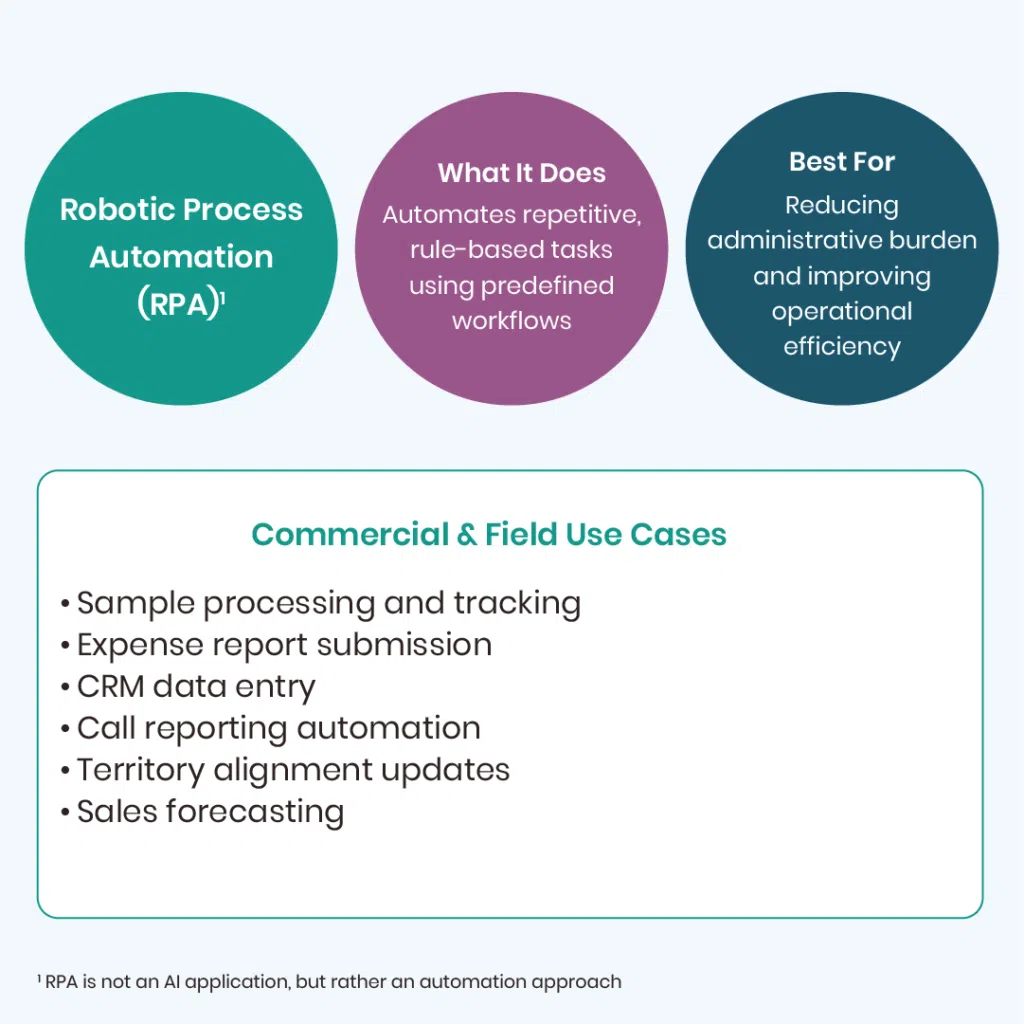
Robotic Process Automation (RPA)
According to UiPath, robotic process automation (RPA) “uses software robots to automate repetitive, rule-based tasks like data entry and system integration.” For example, if you are filling out a form online and have already fed the computer your details, it is able to automatically fill out new forms that require those details. RPA is technically not a type of AI since it relies on fixed rules and inputs, whereas AI “involves self-learning systems that can analyze data, make decisions and adapt over time,” but it is often a part of the broader AI conversations.
What it is: Rules-based automation (not actually AI)
Best for: Reducing administrative burden of high-volume, repetitive tasks with clear rules
Field Excellence Use Cases:
- Sample processing and tracking
- Expense report submission
- CRM data entry and call reporting
- Territory alignment updates
- Sales forecasting data collection
Large Language Models (LLMs)
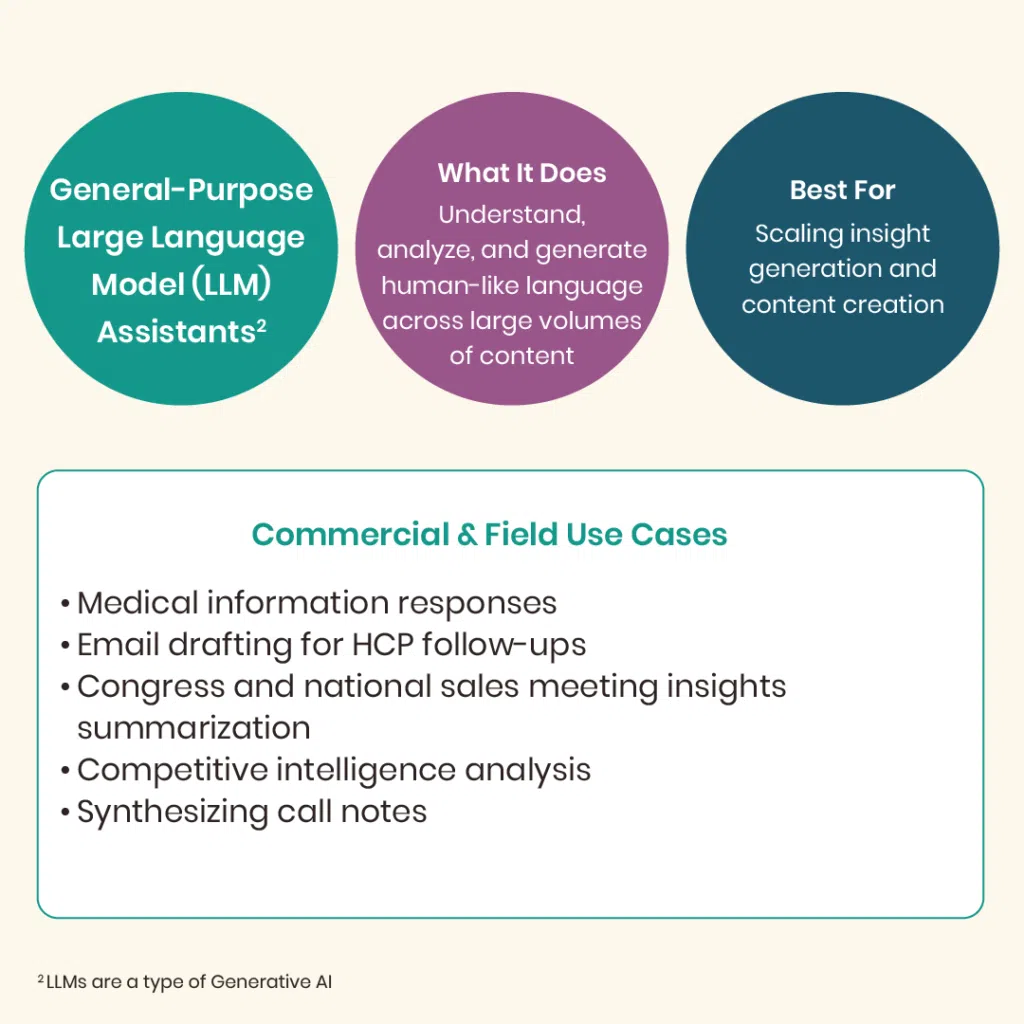
Large Language Models are the type of generative AI you and your team are most likely to be familiar with. Popular general-purpose LLM assistants like ChatGPT and Claude have exploded in popularity over the last few years. A user types in a prompt written in human language, and the system uses massive text datasets to generate a response in human language.
LLMs are best for content-heavy work that requires analysis of unstructured data. For example, a rep quickly takes bullet point notes at the sessions from their national sales meeting. They get back home and want to clean up these notes into something they can refer to later. Before LLMs, the rep would need to clean up the notes manually, which could take hours. A company-approved LLM assistant can clean up their notes into something more coherent within seconds, and even identify trends across sessions.
What it is: AI that understands and generates human language
Best for: Scaling insight generation and content creation
Field Excellence Use Cases:
- Medical information response drafting
- HCP follow-up email generation
- Congress and sales meeting summarization
- Competitive intelligence analysis
- Call note synthesis across territories
The critical thing to remember about LLMs is: garbage (or nothing) in, garbage out. LLMs thrive on as much context as possible, which humans need to provide. If it doesn’t have enough context, chances are it will generate an output so generic or inaccurate that it isn’t helpful. LLMs still require accurate human input to ensure quality control and compliance.
You may have also heard the term “Generative AI”, and are wondering where this falls on this list. Generative AI is an umbrella term for any AI that creates new content, so you can think about LLMs as a type of Generative AI.
AI Agents
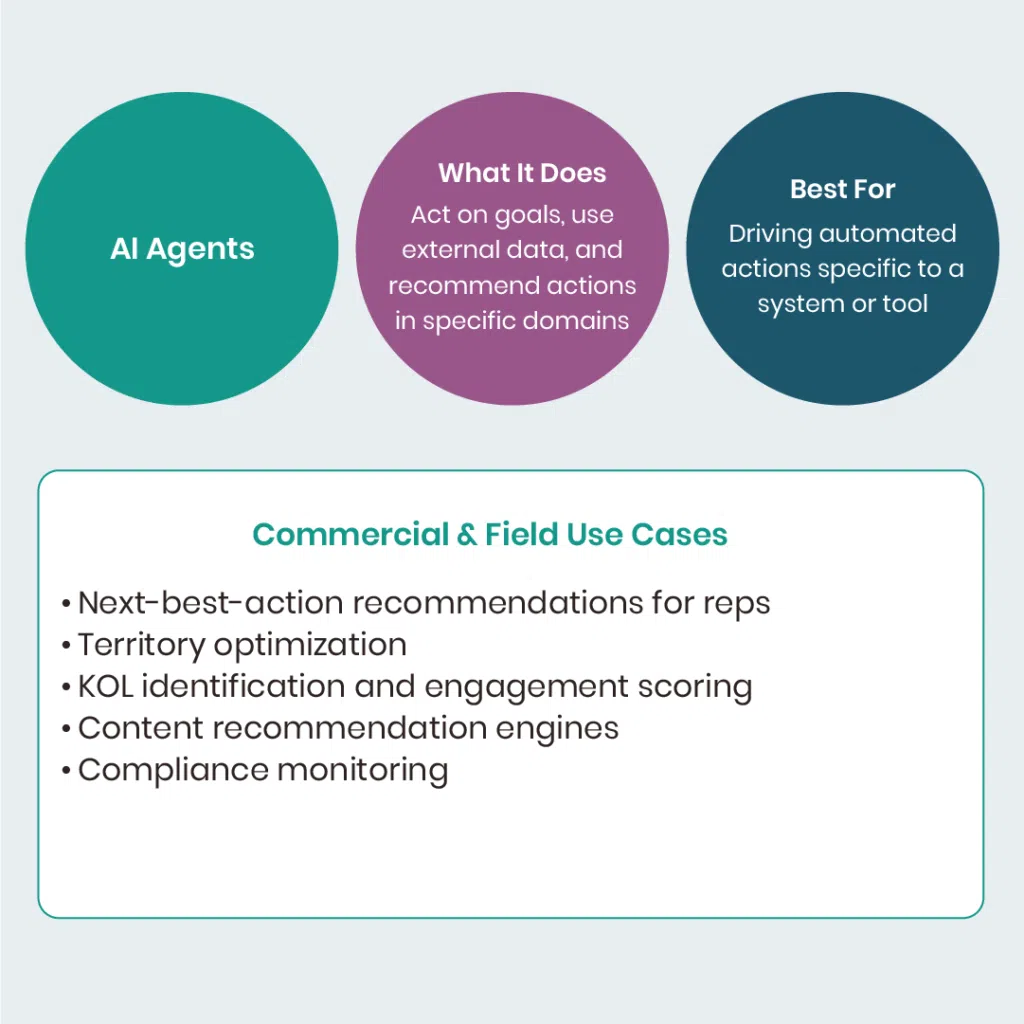
According to IBM, an AI agent refers to “a system or program that can autonomously complete tasks on behalf of users or another system by designing its own workflow and by using available tools.” Agents are most effective when limited to a specific scope of actions and data. In the Life Sciences industry in field operations, these agents can be trained on domain-specific data—like market performance metrics, HCP prescribing patterns, and engagement trends—to provide intelligent recommendations and automated actions that can give your team more bandwidth for more high-priority items.
AI Agents take many of the capabilities of LLMs a step further. While an LLM can analyze data and generate content, an AI Agent can use that analysis to recommend and execute specific actions based on your business goals. Think of it this way: an LLM can summarize call notes from across your territories, but an AI Agent can analyze those notes along with prescription data, HCP engagement history, and competitive activity to recommend which accounts your team should prioritize this quarter and complete automated actions when data inputs change.
What it is: AI that analyzes data and recommends or executes specific actions in a scoped domain
Best for: Data-driven decision support
Field Excellence Use Cases:
- Next-best-action recommendations (who to call, what to discuss, which channel)
- Territory optimization using real-time data
- KOL identification and engagement scoring
- Content recommendation engines matched to HCP needs
- Compliance monitoring and risk flagging
Agentic AI
Agentic AI is the bleeding edge of AI applications in commercial operations; many organizations are still laying the right foundations for this kind of system to operate. As Workday notes, Agentic AI “combines multiple AI models in an orchestrated, integrated way to allow a program to act autonomously within a broader environment. It uses reasoning, learning, and iterative planning to handle dynamic and multistep challenges within an organization.”
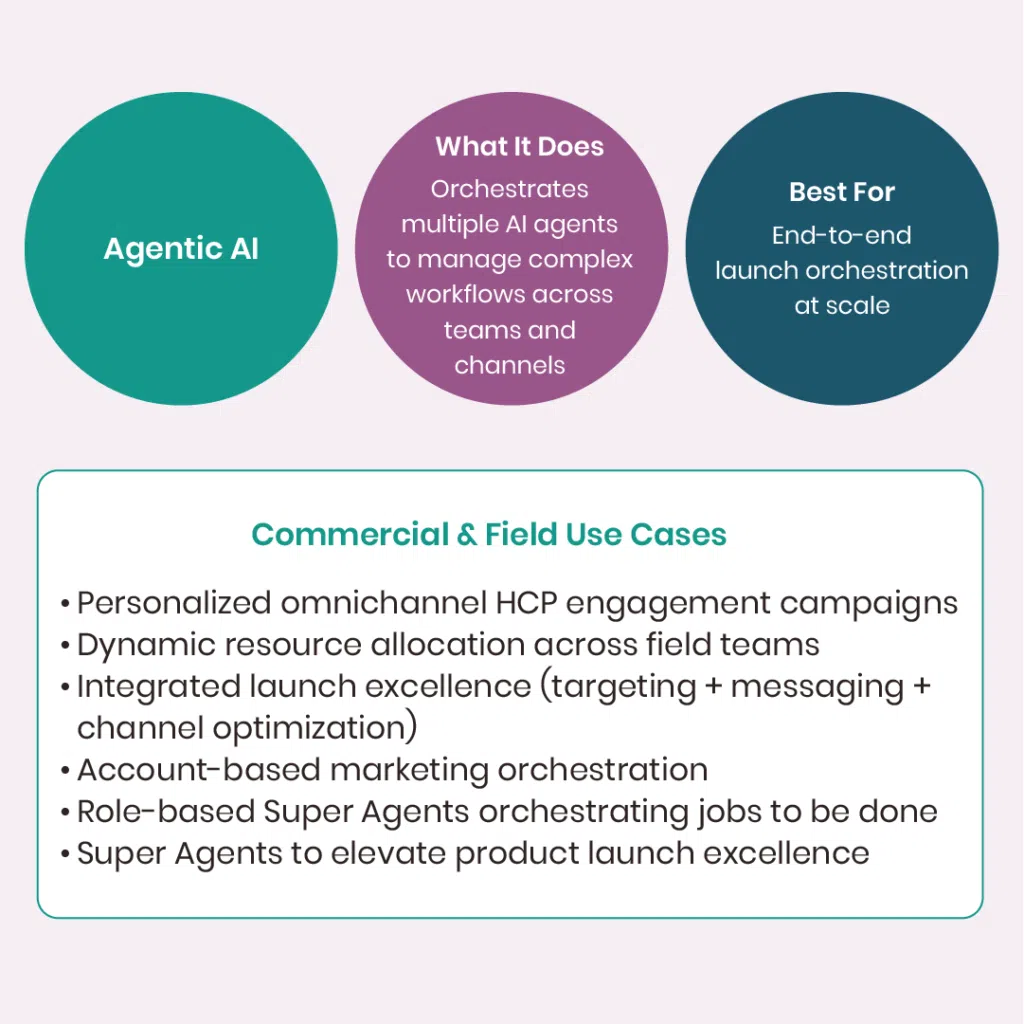
While a single AI Agent handles one specific function (like optimizing territory coverage), Agentic AI orchestrates multiple specialized agents working together autonomously to manage complex, end-to-end commercial workflows. For example, imagine planning a product launch: one agent identifies optimal HCP segments across all territories, another determines the best messaging strategy for each segment, a third coordinates the right mix of field engagement and digital channels, and a fourth dynamically reallocates marketing budgets and sample inventory based on early regional performance—all working in concert without your team who manually coordinates between systems and validates the Agentic AI system’s outputs.
What it is: Multiple AI agents working together autonomously
Best for: End-to-end commercial or medical orchestration
Field Excellence Use Cases:
- Personalized omnichannel HCP engagement campaigns
- Dynamic resource allocation across field teams
- Integrated launch excellence (targeting + messaging + channels)
- Account-based marketing orchestration
- Role-based Super Agents orchestrating jobs to be done
- Super Agents to elevate product launch excellence
Your Next Steps
One simple next step you can take in your AI for Field Excellence journey is to ask questions:
- Where is your team spending time on low-value, repetitive work? –> Start with RPA
- Where are insights buried in unstructured content? –> Deploy LLMs
- Where do decisions and actions lack data-driven support? –> Implement AI Agents
- Where are workflows fragmented across systems? –> Explore Agentic AI
We hope that this guide has given you a solid foundation for understanding the available technologies and how they can drive field excellence! As you go deeper with your AI journey, remember that these technologies are meant to augment humans, not replace them.
Ready to accelerate your AI journey? Connect with us: acto.com/connect