
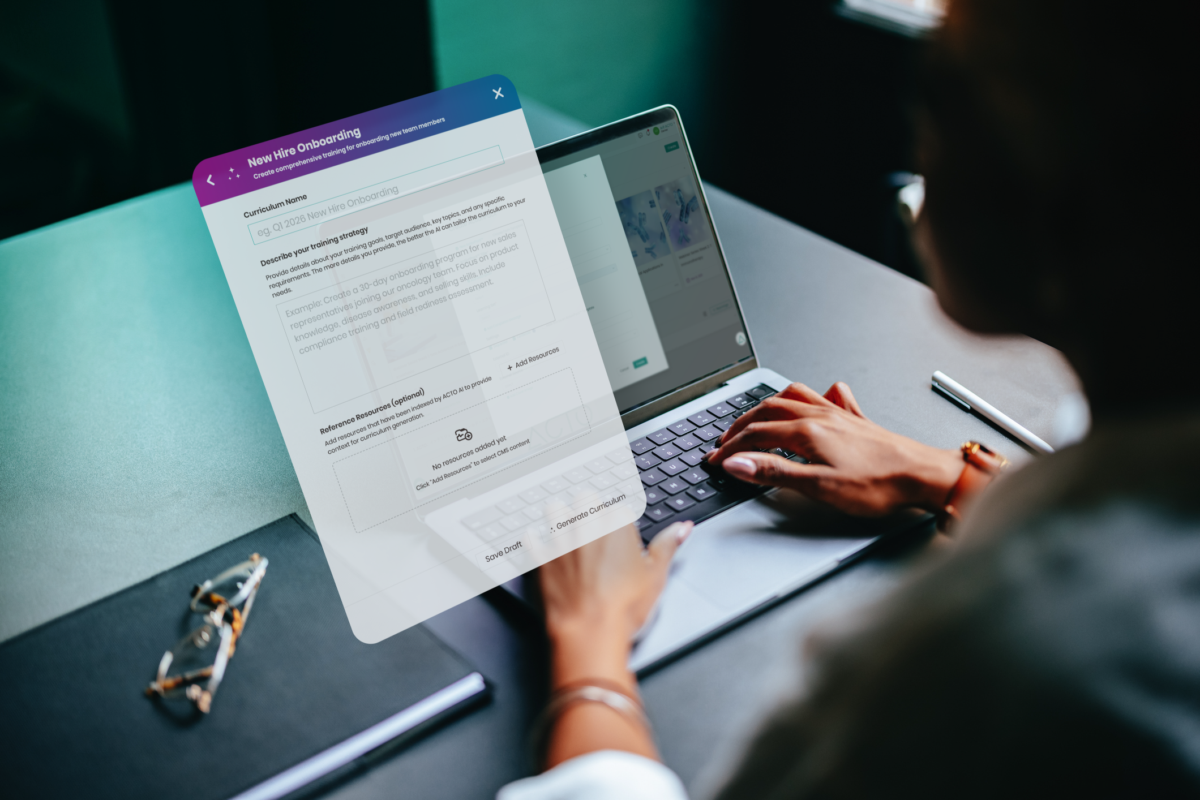
Life sciences organizations are being asked to move faster than ever.
Therapies are becoming more complex. And commercial organizations are expected to deliver stronger field execution, often with leaner teams.
Yet behind the scenes, the workflows supporting field performance remain largely manual:
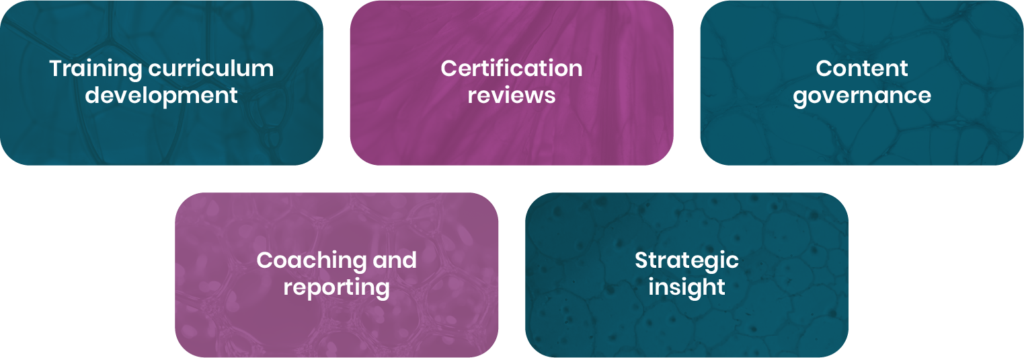
These processes are critical for field readiness and compliance. But they also consume enormous amounts of time, pushing back when sales representatives and MSLs can get into the field. Because field professionals cannot engage HCPs until they are fully trained and certified, slow training and certification cycles become a direct barrier to productivity and impact.
Artificial intelligence is beginning to change that.
AI agents can reduce manual tasks across the workflows that slow commercial execution through intelligent workflow automation, while keeping humans in control.
When administrative friction is removed, life sciences teams gain something far more valuable: time to focus on supporting field professionals while they are out in their territories.
How AI helps life sciences field teams
AI workflow agents improve life sciences field team performance by reducing tasks that most often slow commercial execution.
These include:
- Training program development
- Certification review and scoring
- Coaching documentation and reporting
- Content governance and asset management
- Field insight generation from dashboards and analytics
By automating these administrative tasks—while keeping humans responsible for review and approvals—AI workflow agents help commercial teams move faster, maintain compliance, and spend more time strengthening field performance.
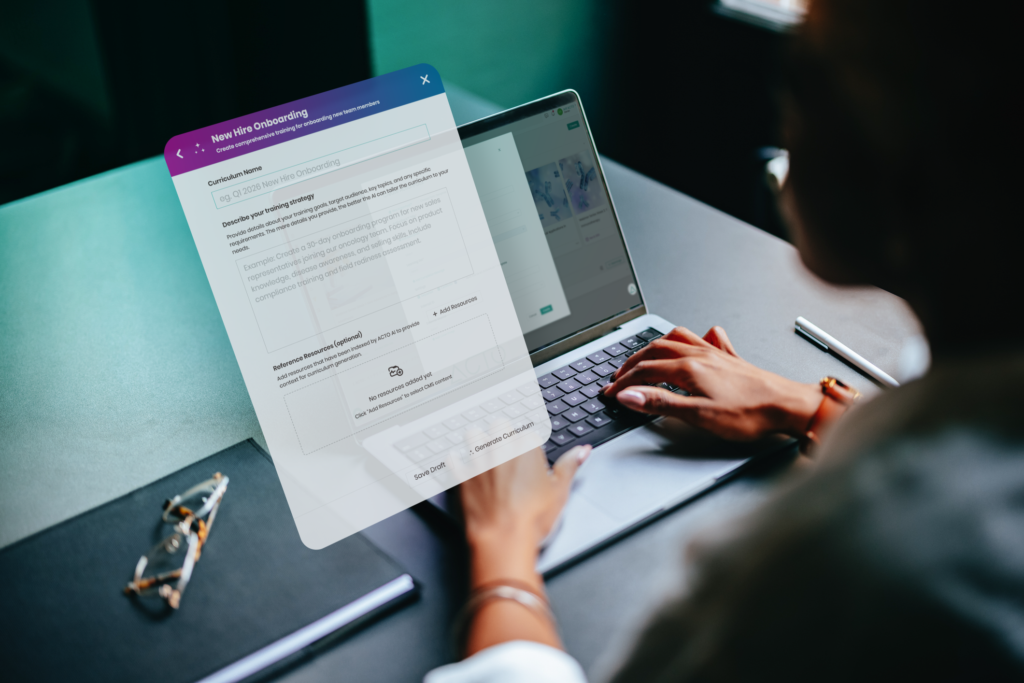
“We built ACTO AI workflow agents to eliminate high-friction workflows, helping teams move beyond managing tasks to delivering real impact.”
– Parth Khanna, CEO of ACTO
Why manual workflows slow down life sciences commercial teams
Most commercial organizations recognize the importance of strong field enablement.
But the processes behind it often haven’t evolved.
- Learning teams still spend weeks building training programs from scratch.
- Certification reviews still require manual scoring and documentation.
- Managers still spend hours writing coaching reports.
- Administrators still manage sprawling and often disorganized content libraries.
- Leaders still dig through data to find answers.
Each of these workflows exists for good reasons: compliance, consistency, and accountability.
But together, they create significant operational friction.
Common examples include:
- Training programs are taking 45–60 days to develop
- Certification videos requiring manual review and scoring
- Coaching feedback is delayed by documentation work
- Content libraries are becoming harder to govern as they scale
- Field insights are buried across multiple reporting systems
Not one of these activities is optional.
But they shouldn’t be the reason organizations struggle to move quickly during critical moments like product launches, onboarding new field teams, or responding to market shifts.
What is AI workflow automation for life sciences field teams?
AI workflow automation for life sciences field teams refers to using artificial intelligence to reduce manual work across commercial enablement workflows—such as training development, certification review, coaching documentation, content governance, and field analytics—while maintaining human oversight and regulatory compliance.
In regulated environments like life sciences, the most effective AI workflow agents include human-in-the-loop.
This means AI agents assist with analysis, drafting, and recommendations while people remain responsible for review, approval, and final decisions.
The goal is not to replace expertise.
The goal is to remove the administrative friction around expert work.
How AI speeds up learning program development in life sciences
Creating a comprehensive learning program is one of the most time-intensive responsibilities for commercial learning teams.
Training leaders must coordinate with subject matter experts, structure content, develop lessons, quiz development, and align certification requirements.
Even highly experienced teams may spend months developing the curriculum and weeks building the first version of a training program.
AI changes the starting point.
Instead of beginning with a blank page, training teams can prompt an AI agent to develop a learning program based on specific material and instruct the agent how many modules and weeks the program should be. The AI agent then drafts the program.
Common materials provided to AI agents for training program creation include:
- Product messaging documents
- Slide decks and clinical materials
- Existing training resources
- Competitive intelligence or launch materials
The structure generated by the AI agent can include lessons, learning paths, quizzes, certifications, and full programs ready for review.
Training teams remain in full control: they review, refine, and approve the final program.
But the heavy lifting of building the framework is dramatically reduced.
The result: less time assembling programs and more time improving learning quality.
How AI improves certification reviews for field teams
Video-based certifications are widely used to confirm field readiness by observing field professionals’ verbalization of critical product messaging.
But reviewing these submissions manually is time-consuming.
Reviewers must watch each recording, evaluate responses against defined criteria, assign scores, and document feedback.
AI agents can assist certification by:
- Analyzing recordings against predefined evaluation criteria
- Generating structured evaluation drafts
- Highlighting where responses align or miss expectations
- Producing transparent scoring rationales
This allows AI to perform the first-pass evaluation, while human reviewers validate or adjust the final assessment.
Using AI to review certifications also removes bias and inconsistency that naturally occur with human review and assessment.
The result of an AI-assisted certification process is faster, more scalable, and more consistent—while keeping humans in control.
How AI reduces coaching documentation for field managers
Ride-alongs and field coaching are strong drivers of performance improvement.
But documenting in field coaching reports (FCRs) often takes time away from the coaching itself.
Managers frequently spend hours writing summaries, recording observations, and documenting follow-up actions. AI can assist by generating structured FCR drafts from notes, structured inputs, or recorded interactions.
Managers can then review, edit, and finalize the summary.
Less time spent writing reports means more time spent coaching the field.
And faster documentation means feedback reaches field professionals sooner.
How AI supports compliant content governance
Content governance becomes increasingly complex as life sciences organizations grow.
Commercial teams generate large volumes of materials: from training content and product messaging to clinical updates and competitive insights.
Over time, content libraries accumulate:
- Duplicate files
- Inconsistent naming conventions
- Outdated materials
- Assets that are difficult to locate
Managing these issues manually can become a full-time administrative effort.
AI workflow agents can support governance by helping teams:
- Identify duplicate or overlapping assets
- Standardize metadata and naming conventions
- Flag outdated or expiring content
- Improve searchability across repositories
For regulated industries like life sciences, this matters enormously.
Stronger governance helps ensure field teams can always access the most current, approved materials.
How AI helps leaders get insights from field data faster
Senior leaders rely on field data to understand training readiness, coaching activity, certification outcomes, and commercial performance.
But extracting insights from databases and other structured or unstructured sources often requires navigating multiple systems and reports. Trying to draw meaningful insight in this manner is mind-numbing.
AI agents can simplify this process.
Leaders can ask natural language questions such as:
- Which teams are behind on certification readiness?
- What coaching themes appear most frequently?
- Which training programs correlate with stronger performance?
- Where are content usage gaps across regions?
AI agents can surface answers instantly by analyzing the underlying data.
This dramatically shortens the time between question and insight, enabling faster strategic decisions.
Traditional workflows vs AI-assisted field enablement
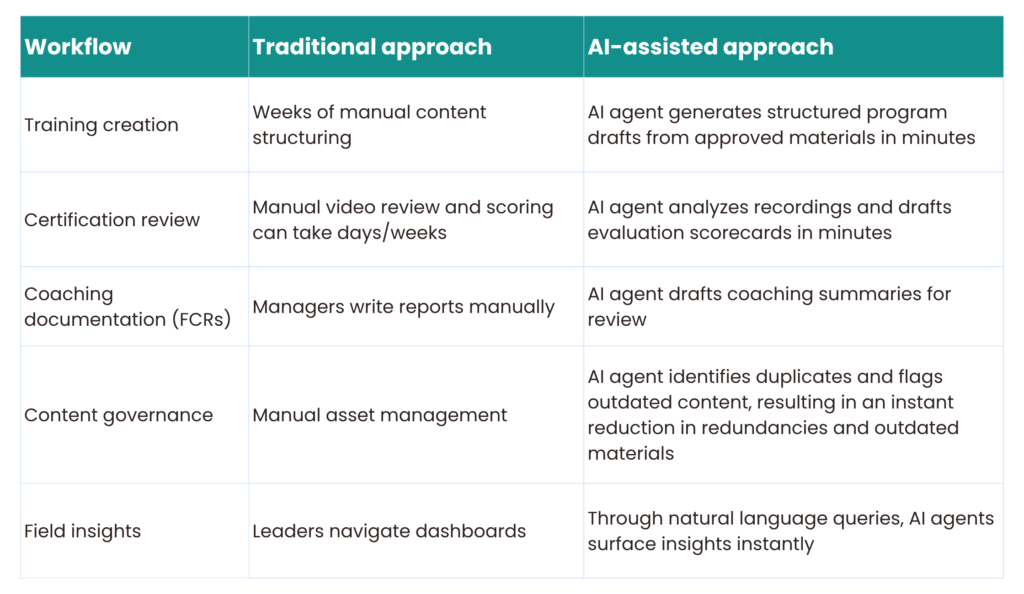
How ACTO AI workflow agents support life sciences field workflows
ACTO AI agents apply intelligent workflow automation to the operational tasks that most often slow life sciences field teams.
ACTO AI workflow agents help commercial organizations:
- Generate learning programs in as little as one week
- Execute certification evaluations in less than 30 seconds
- Draft coaching summaries and follow-up documentation
- Maintain stronger governance across growing content libraries
- Surface insights from field data through conversational analytics
Across these workflows, the goal is consistent: reduce manual effort while keeping humans in control of the decisions that matter most.
“We built ACTO AI workflow agents to eliminate high-friction workflows—helping our customers move beyond managing tasks to delivering real impact,” said our CEO, Parth Khanna.
Key takeaways: AI for life sciences field enablement
- Life sciences field teams spend significant time on manual workflows, including training development, certification reviews, coaching documentation, and content governance.
- These workflows are essential for compliance and readiness, but can slow field execution when handled manually.
- AI workflow agents reduce administrative workload through intelligent workflow automation across training, certification, coaching, governance, and insights.
- Human-in-the-loop models ensure organizations maintain compliance oversight while benefiting from automation.
- ACTO AI workflow agents are purpose-built for life sciences field enablement environments.
FAQ: AI for life sciences field team enablement
What is AI workflow automation in life sciences field enablement?
AI workflow automation refers to using artificial intelligence to reduce manual processes in training, certification, coaching, content governance, and reporting while maintaining human oversight.
How can AI help pharmaceutical sales training teams?
AI workflow agents help training teams generate structured learning programs, create assessments faster, and reduce the time required to develop and update training content.
Can AI be used for certification reviews in regulated environments?
Yes. In a human-in-the-loop model, AI can assist with evaluations and scoring rationales, while trained reviewers validate and approve final outcomes.
How does AI improve coaching documentation for field managers?
AI workflow agents generate coaching summaries, action items, and follow-up notes—reducing administrative time and accelerating feedback delivery.
How can AI support content governance for pharma field teams?
AI workflow agents help identify duplicate assets, standardize metadata, and flag outdated content to improve content library management.
The path forward
As life sciences organizations scale their global operations and launch increasingly complex therapies, the workload associated with field enablement will continue to grow.
The organizations that move fastest will rethink how these tasks and workflows are executed.
By using ACTO AI workflow agents to reduce administrative friction across training, certification, coaching, governance, and insight generation, commercial teams can operate more efficiently without sacrificing oversight.
And ultimately, that creates the outcome every life sciences organization is working toward: stronger field execution and faster patient impact.
About ACTO: AI for Life Sciences Field Excellence
ACTO is a life sciences technology company focused on improving how pharmaceutical, biotech, and medtech organizations prepare and support their field teams after therapies receive regulatory approval.
The ACTO platform combines human expertise with empathetic AI to help commercial teams accelerate product launches, strengthen field execution, and improve customer engagement.
ACTO AI workflow agents apply intelligent workflow automation to the operational tasks that often slow life sciences field teams, including training development, certification reviews, coaching documentation, content governance, and field insight analysis.
Trusted by 14 of the top 50 pharmaceutical companies, high-growth biotech companies, and leading medtech organizations, ACTO supports more than 50,000 field professionals and 5,000 administrators globally.
The platform is built to meet the industry’s highest regulatory standards and is FDA 21 CFR Part 11 validated and SOC 2 Type II certified.