
ACTO’s role-based SuperAgents are purpose-built to orchestrate work for Life Sciences professionals to simplify their jobs and elevate performance through empathetic, connected, and compliant AI.
Agent Skill Accuracy
85%
Field Sales Professional




The Life Sciences industry is under enormous pressure to support expanded product portfolios and compressed launch timeframes, despite a significant human capital gap.
This has led to a demand on commercial, medical, and product launch teams to “do more with less.”
The good news? AI is here. The bad news? To date, AI has exacerbated the problem, rather than alleviating it.
AI solutions have been developed by system and application providers to make using their platforms easier, which is great for workflow, but not necessarily great for the workforce.
Across traditional functions, Life Sciences professionals typically use 10-18 systems and applications to do their jobs each day. As a result, even though AI may streamline tasks within individual tools, the broader burden of navigating multiple systems—and now multiple, disconnected AI agents—has only intensified.
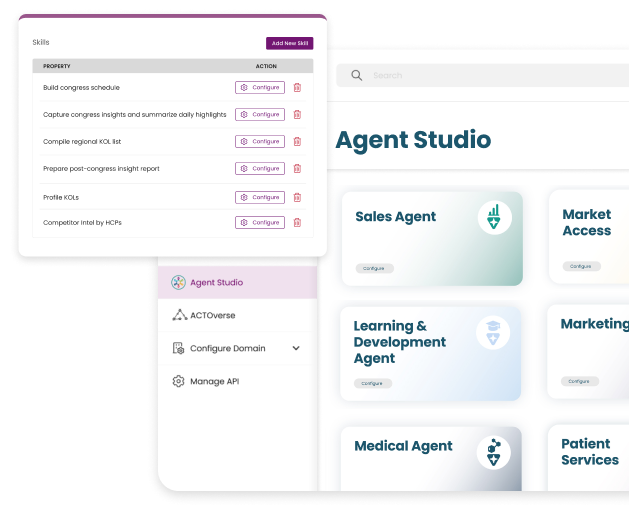
What the industry really needs are AI agents that are role-based.



Plan My Day

Clinical Paper Summary

Pre-call Planning
While human capital challenges affect all areas of Life Sciences organizations, the pressure to “do more with less” is most acute in customer-facing functions that have undergone significant layoffs, downsizing, and restructuring—particularly Sales, Medical, Marketing, Patient Services, Market Access, and Learning & Development.
When AI agents are designed to support roles rather than systems, Life Sciences organizations can apply AI more strategically. Instead of optimizing individual tasks or workflows in isolation, teams can evaluate AI based on its impact on end-to-end use cases and business outcomes.
Several high-value use cases in Life Sciences consistently demand improvement, including:
“I’ve had the privilege of working across every facet of commercial strategy—from launching brands and building field teams to improving market access. The way our industry interacts with healthcare professionals, patients, and payors is undergoing seismic change. AI is not a luxury—it’s essential. ACTO is uniquely positioned to lead this transformation.”
~ Lori Tierney, former President, J&J Vision
“ACTO has changed the way our sales force operates in a very positive way. We love how it speeds up our sales cycle, puts time back in our day and encourages continuous learning.”
— Ryan Kindig, Sales Trainer and Territory Manager, Monaghan Medical
“Helping our field-based teams have impactful, personalized conversations with HCPs is the ultimate goal. ACTO helps make this possible by giving field professionals fast, role-specific access to the knowledge they need, along with relevant suggestions — improving pre-call planning and raising the quality of every HCP interaction.”
— Lisa Dreher, Director of National Sales Training, Currax Pharmaceuticals
To be viable in this environment, AI agents must be built around three core principles:
To deliver accurate, role-specific guidance
With other agents and enterprise systems
To ensure continuous compliance
See how ACTO’s role-based SuperAgents can transform your Life Sciences workforce.
Agentic AI is AI that can act independently to achieve a goal.
Agentic AI continuously plans, acts, checks results, and adapts until it reaches a goal.
Different types of AI agents include Reactive agents that respond immediately to prompts, but do not have any memory or ability to plan; goal-based agents that take actions to achieve a certain objective; planning agents that break goals into multi-step plans and execute them in order; learning agents that improve over time based on feedback or data; tool-using agents that use external tools, APIs, or software to get work done; super agents that are hyper context-aware, connected to other systems and agents, and execute based on human instruction and compliance guardrails.
The best type of AI agents for professionals in the highly regulated Life Sciences industry are role-based SuperAgents that are empathetic, connected, and compliant.
Life Sciences professionals typically use 10-18 systems and applications to do their jobs each day, which may result in having to use several disconnected system-based AI agents; whereas, role-based AI agents are designed to support an individual as a single point of contact to execute on their behalf, across systems and other AI agents. This simplifies the experience and reduces the burden on individuals at Life Sciences companies.
In this highly regulated industry, Life Sciences companies should look for agentic AI solutions that are hyper-context aware, connected to systems and agents, and adhere to strict compliance guardrails.
The functional areas within the Life Sciences industry that could benefit most from role-based agents are field-facing functions that have undergone significant layoffs, downsizing, and restructuring such as Sales, Medical, Marketing, Patient Services, Market Access, and Learning & Development.
Several high-value use cases in Life Sciences that could benefit from the use of agentic AI include product launches, rapid upskilling of field teams, field excellence and execution, and patient support, market access & field reimbursement.
Roles in Life Sciences that should be prioritized for agentic AI include Sales Representatives, Medical Science Liaisons, Key Account Managers, and Patient Support and Reimbursement Specialists.
Contextual awareness means that the AI agent understands more than just the prompt – it knows who the individual is who is asking the prompt, it has memory of prior “conversations,” it understands the goal of the prompt, and it understands the environment in which the prompt was made.
Contextual awareness is important because it makes AI more useful, accurate, and trustworthy.
Empathetic AI means that the AI agent understands the person who is asking the question or commanding the action and responds in a personalized and appropriate way.
Empathetic AI is important because it ensures that AI responses are appropriate, accurate, and relevant.
While there are currently no universal governance or compliance standards for AI agents or agentic AI systems in Life Sciences, the following best practices are recommended to help ensure compliance when launching AI agents or agentic AI systems:
To get started with agentic AI in Life Sciences, identify the roles in your organization that are under the most pressure to “do more with less” and have a significant impact on the commercial performance of the business. For example, field-facing functions that have undergone significant layoffs, downsizing, and restructuring such as Sales, Medical, Marketing, Patient Services, Market Access, and Learning & Development
There is a massive Human Capital Gap between what field leaders are being asked to deliver and the human capital available to deliver.
Technology doesn’t earn trust by being impressive. It earns trust by being accurate, relevant, and human, especially in the moments that matter most.
Picture this: you’re a new medical science liaison (MSL) at a top pharma company.